
- 16MM Cutter 2 Pocket Suitable To APMT 11
- 3-Flute Aluminum End Mill
- 32 MM Indexable Endmill 3 Pocket For APMT 1604
- Carbide drill 45 HRC
- Drill Sleeve
- Face Grooving Boring Bar
- Flat Endmill 55 HRC
- Profiled Point Revolving Center
- Solid Car Bide Drill
- Spade Drill
- Standard Point Revolving Center
- Stub Point Revolving Center
- Turret Socket Sleeve
- Universal MS/SS Endmill
Complete Guide to Turning Insert: Types, Uses, and CNC Applications

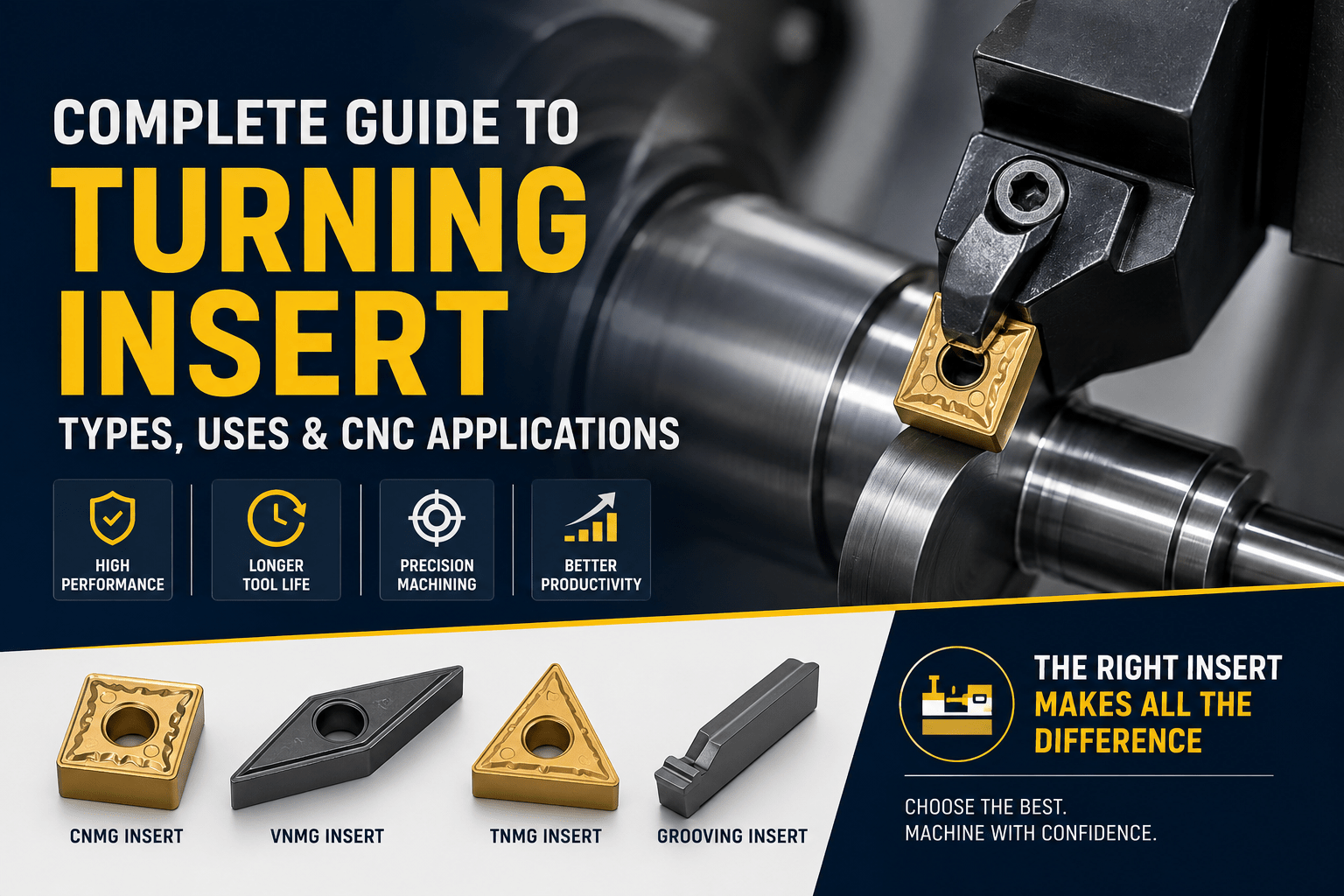
In modern CNC machining, choosing the right turning insert can make a huge difference in cutting performance, tool life, surface finish, and production cost. Whether you are a beginner learning CNC machining, a workshop owner, or a professional machinist, understanding turning inserts is essential for efficient metal cutting operations.
From CNMG insert options to different lathe inserts and grooving tools, every insert is designed for a specific machining purpose. In this guide, you will learn about the different turning inserts types, their applications, materials, and how to choose the best insert for your CNC turning operations.
What Is a Turning Insert?
A turning insert is a replaceable cutting tip used in CNC lathes and turning machines. It is mounted on a tool holder and performs cutting operations such as:
- Turning
- Facing
- Grooving
- Threading
- Profiling
These inserts are usually made from hard materials like carbide, ceramic, CBN, or coated alloys to withstand high temperatures and cutting pressure.
Unlike traditional cutting tools, inserts can be replaced easily when worn out, saving time and reducing tooling costs.
Why Turning Inserts Are Important in CNC Machining
Using the correct turning insert improves:
- Surface finish quality
- Tool life
- Cutting speed
- Productivity
- Dimensional accuracy
- Machine efficiency
In industries like automotive, aerospace, manufacturing, and engineering, inserts help maintain consistent machining performance even during high-volume production.
Different Turning Inserts Types
There are several turning inserts types available in the market. Each insert shape and design is suitable for a specific cutting application.
CNMG Insert
The CNMG insert is one of the most commonly used inserts in CNC turning.
Features:
- Diamond-shaped insert
- Double-sided cutting edges
- Strong edge strength
- Excellent for roughing operations
Applications:
- Heavy metal removal
- Steel machining
- Cast iron cutting
- General-purpose turning
CNMG inserts are widely preferred because they provide durability and cost efficiency.
H3: VNMG Insert
VNMG inserts have a sharper cutting angle compared to CNMG inserts.
Best For:
- Finishing operations
- Precision turning
- Profile machining
These inserts provide better surface finish but are slightly weaker for heavy cutting.
TNMG Insert
TNMG inserts have a triangular shape and offer multiple cutting edges.
Advantages:
- Economical
- Good chip control
- Suitable for medium cutting applications
Grooving Insert
A grooving insert is specially designed for groove cutting operations.
Common Uses:
- O-ring grooves
- Internal grooves
- External grooves
- Parting operations
Grooving inserts are available in different widths depending on groove size requirements.
Types of Lathe Inserts Based on Material
Different lathe inserts are manufactured using different materials. The insert material directly affects cutting performance and tool life.
Carbide Inserts
Carbide inserts are the most popular choice in CNC machining.
Benefits:
- High wear resistance
- Excellent hardness
- Suitable for high-speed machining
Ideal For:
- Steel
- Stainless steel
- Cast iron
- Aluminum
Ceramic Inserts
Ceramic inserts are used for high-speed finishing operations.
Advantages:
- Heat resistance
- Faster cutting speed
- Better finishing
However, they are more brittle than carbide inserts.
CBN Inserts
CBN (Cubic Boron Nitride) inserts are used for hard material machining.
Suitable For:
- Hardened steel
- Heat-treated components
These inserts are commonly used in automotive and aerospace industries.
How to Choose the Right Turning Insert
Selecting the right turning insert depends on several factors.
Material Being Machined
Different materials require different insert grades.
| Workpiece Material | Recommended Insert |
|---|---|
| Steel | CNMG carbide insert |
| Stainless Steel | Coated carbide insert |
| Aluminum | Sharp polished insert |
| Cast Iron | Ceramic or carbide insert |
Cutting Operation
Choose inserts according to operation type:
- Roughing → CNMG insert
- Finishing → VNMG insert
- Grooving → Grooving insert
- Threading → Threading insert
Cutting Speed and Feed
High-speed machining requires heat-resistant inserts. Lower speeds may work efficiently with standard carbide inserts.
Surface Finish Requirement
For smooth surface finish:
- Use sharp-edge inserts
- Reduce feed rate
- Select finishing inserts
Advantages of Using CNC Turning Inserts
Modern CNC machining relies heavily on replaceable inserts because they offer many advantages.
Key Benefits
1. Cost Efficiency
Instead of replacing the entire tool, only the insert is changed.
2. Faster Tool Changes
Quick insert replacement reduces machine downtime.
3. Improved Productivity
Optimized inserts allow higher cutting speeds.
4. Better Consistency
CNC inserts provide uniform machining quality.
5. Versatility
One tool holder can use multiple insert types.
Common Problems in Turning Inserts
Even high-quality inserts can face issues during machining.
Excessive Wear
Causes:
- High cutting speed
- Incorrect insert grade
- Poor coolant usage
Solution:
Use proper insert coating and recommended cutting parameters.
Chipping
Causes:
- Interrupted cuts
- Excessive feed
- Weak insert geometry
Solution:
Use stronger inserts like CNMG inserts for roughing.
H3: Poor Surface Finish
Causes:
- Worn insert
- Wrong nose radius
- Vibration
Solution:
Use finishing inserts and proper machine setup.
Industries That Use Turning Inserts
Turning inserts are used across many industries.
Major Industries:
- Automotive
- Aerospace
- Oil & gas
- Tool manufacturing
- General engineering
- Medical equipment manufacturing
These industries depend on CNC machining for precision and productivity.
Tips to Increase Turning Insert Life
To maximize insert performance:
- Use proper coolant
- Follow recommended speeds and feeds
- Avoid excessive vibration
- Select the correct insert geometry
- Replace worn inserts on time
- Use high-quality tool holders
Proper maintenance can significantly improve machining efficiency and reduce tooling costs.
Future of CNC Turning Inserts
The CNC tooling industry continues to evolve with advanced coatings and smart insert technology.
Modern inserts now offer:
- Better chip control
- Longer tool life
- Heat-resistant coatings
- Higher machining accuracy
As automation and CNC technology grow, demand for high-performance turning inserts will continue increasing.
Conclusion
A turning insert is one of the most important components in CNC machining. Whether you are using a CNMG insert, lathe inserts, or a grooving insert, selecting the correct insert improves productivity, machining quality, and overall cost efficiency.
Understanding different turning inserts types helps machinists and business owners make better tooling decisions for roughing, finishing, grooving, and precision operations.
If you want better machining performance, longer tool life, and smoother finishes, investing in the right CNC turning inserts is essential.
FAQs About Turning Inserts
1. What is a turning insert used for?
A turning insert is used in CNC lathes for cutting, turning, facing, grooving, and shaping metal components.
2. What is a CNMG insert?
A CNMG insert is a diamond-shaped carbide insert commonly used for roughing and general turning operations.
3. Which turning insert is best for finishing?
VNMG inserts are usually preferred for finishing because of their sharp cutting edges and better surface finish capability.
4. What is the difference between grooving inserts and turning inserts?
Grooving inserts are specially designed for groove cutting and parting operations, while standard turning inserts are used for general machining tasks.